You didn't lose your strength.
You lost the space to show it.
A practical system for navigating awkward questions, pity, boundaries, and social exhaustion after disability.
Set boundaries without guilt
Respond to pity without emotional exhaustion
Protect your energy in social situations
Use practical scripts for real conversations
Digital Download • Read At Your Own Pace • No Deadlines
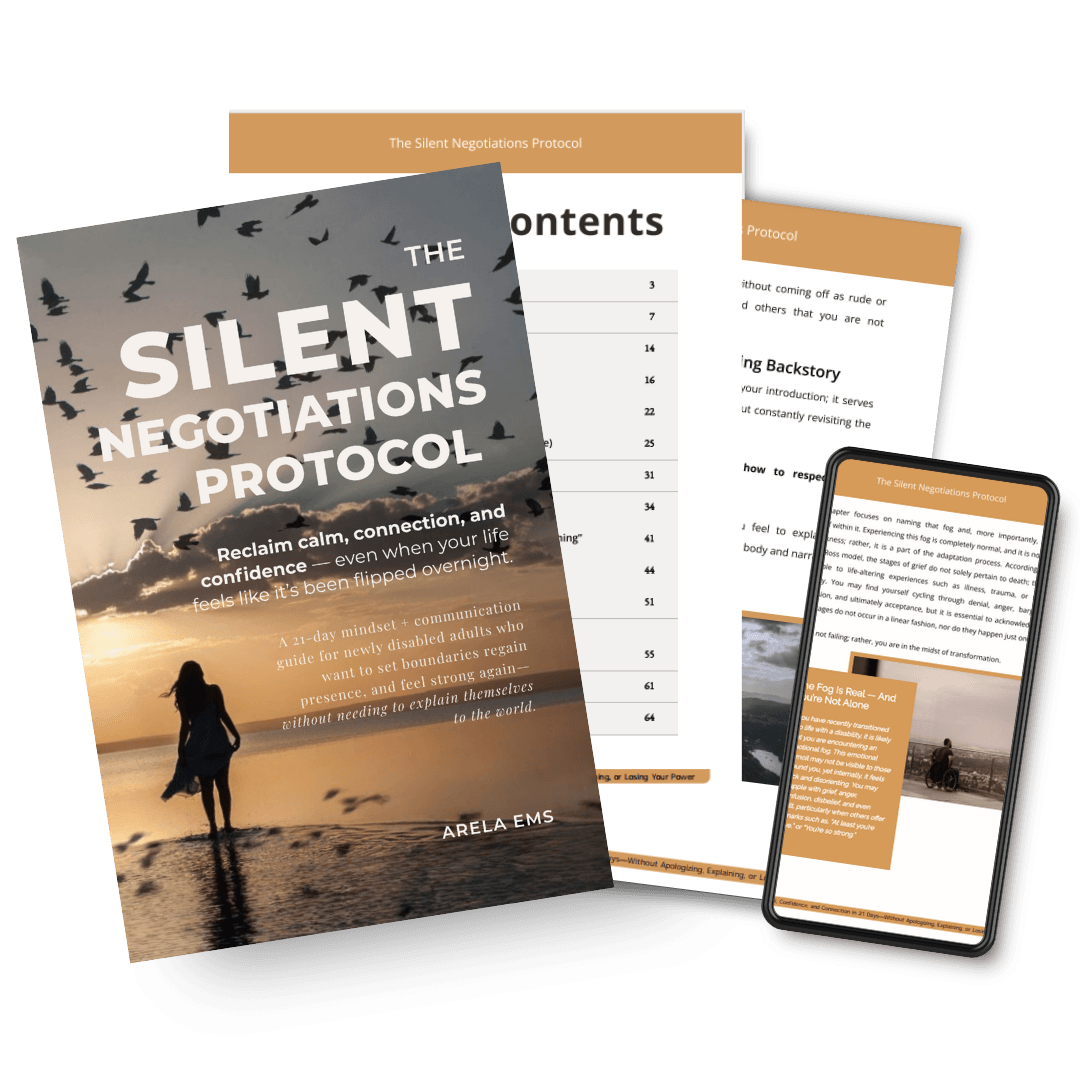
Medical. Legal. Physical. But not social.
Most resources do a good job covering the clinical side. The gap is everything else.
"That's the gap this protocol fills — the hidden social side of disability that nobody talks about, and almost nobody teaches."
Nobody teaches the social side of disability.
Doctors teach recovery.
Therapists teach coping.
Support groups teach connection.
But almost nobody teaches:
what not to say
how to handle pity
how to stop over-explaining
The Silent Negotiations Protocol exists to fill that gap.
You woke up one day and the world stopped treating you like the same person.
That's the part nobody prepares you for.
After the accident or illness — everything shifts. Not just your routine. Not just your mobility. But people's reactions. Their faces. Their tone.
Even when you don't say it — it's heavy.
Doors open. People walk in. And suddenly the whole room shifts because of your presence. Some fall silent. Some pretend they didn't look. Some give a half-smile na hindi mo alam kung concern ba o pity.
And you're just there — minding your own business — pero parang ikaw pa ang may kailangan i-manage na reaction nilang lahat.
"You didn't ask for the accident. You didn't choose the diagnosis. Pero ngayon, you're the one adjusting to everyone else's discomfort."
When the doctor asks a question but directs their eyes to your companion. When relatives keep asking the same questions every visit. When someone praises you for something ordinary — and it doesn't feel like a compliment. It feels like pity dressed as encouragement.
People say "Ang strong mo" — pero they don't see how hard you fight just to stay composed.
- You avoid conversations because they drain you before they even start
- You shrink in rooms you used to walk into with confidence
- Every stare feels like a question you didn't agree to answer
- You perform "okay" to protect others — and feel invisible doing it
- You've been carrying everyone else's discomfort while barely carrying yourself
"You're not drained because of what happened to your body. You're drained because of the silent negotiations you're forced into every single day."
Once you understand what's really happening — you can start controlling the negotiation instead of just reacting to it.
What changes — quietly and steadily.
The Three Layers of Silent Negotiation.
Every social difficulty you face after disability lives in one of three layers. The protocol works because it addresses all three — not just the surface one.
Control Your Internal State
- Grounding tools for overwhelm
- Identity anchors after loss
- Internal reframes for pity
- Mirror Moment daily ritual
- Silent Power Hour practice
Control The Interaction
- Ready-made response scripts
- Boundary-setting phrases
- The Pause-Pick-Play model
- "How are you?" toolkit
- Story-protection frameworks
Control The Story
- Nonverbal presence tools
- Quiet authority building
- Author Statement practice
- Main Character identity work
- The quiet comeback system
10 chapters. One real-life problem at a time.
Every chapter opens with a story you'll recognise, builds to a skill you can use the same day, and closes with a Quick Win in under 10 minutes.
The emotional fog after a life-altering diagnosis is real — and it's not weakness. This chapter names the grief, identity disruption, and invisible weight you're carrying. You'll learn your Internal Compass: three grounding questions to centre yourself before you engage with the world.
The Mirror Moment — 90 seconds, any mirror. Look into your own eyes and say: "I am still here. And I get to decide what happens next."
The tilted head, soft eyes, "aww poor you" expression. Psychologists call it benevolent prejudice — a bias that masquerades as kindness. This chapter teaches you to silently reframe pity in real time using the Eye Contact Shift, your Mental Name Tag, and a default response that neutralises the narrative.
The 5-Second Power Reclaim — Spot the look → breathe → reframe internally → hold the gaze → reset posture. Five seconds. The shift lasts all day.
You don't need to say a word to own a room. This chapter unpacks posture, stillness, and the power gaze — and shows you how to use all of it before you speak. Based on Mehrabian's communication research and Amy Cuddy's body language work.
The Enter & Anchor Routine — 60-second sequence: pause at the door, plant and posture, lock the gaze, stay silent, affirm: "I am here. I don't need to explain to belong."
You do not owe anyone your story just because they asked. This chapter gives you a complete toolkit of boundary phrases — calm, kind, and completely firm. For strangers, coworkers, family, and anyone who "just wants to understand."
How to Set a Boundary Without Explaining — Choose your phrase. Say it twice out loud. Use it once this week. Notice how it feels to protect your energy instead of giving it away.
When others become the narrator of your story — calling you brave, making you their inspiration — you lose the pen. This chapter shows you how to use Author Statements to step back into the driver's seat, based on Dr Dan McAdams' narrative identity research.
Claim Your Scene Ritual — 5 minutes in your chosen spot. Power Premise. Sit tall. Write one line of evidence that you showed up today.
Confidence is a signal — and you can send it before you say a word. Five specific nonverbal tools: the Shoulder Reset, Chin Neutral, Take Up Space, Anchor Breath, and Deliberate Movement. Each one shifts both how others see you and how you feel inside.
The 3-Minute Power Posture Reset — Six 30-second steps before any hard moment. Mirror → shoulder roll → chin level → plant your base → power breath × 3 → affirm and enter.
Four words that used to be small talk now feel like a landmine. This chapter gives you a four-option framework: Energy-Saver, Reverser, Reframed, and Boundary Builder — the right response for every context and every energy level.
Build Your "How Are You?" Toolkit in 10 Minutes — Write four responses in your own voice. Save them on your phone. Use one today.
After trauma, we perform "okay" to protect the people around us — and slowly disappear in the process. Psychologists call it emotional labour. This chapter names the survival theatre and gives you the exact language to show up honestly without oversharing.
The Honest Check-In Script — Three sentences: gratitude + honest emotional state + permission to connect anyway. Try it once with someone you trust.
Every conversation is a choice — not a trigger. The Pause-Pick-Play model gives you a real-time filter: pause (breathe), pick (educate / redirect / set a boundary / say nothing), play (deliver with calm clarity). Power is having the option.
The 3-Sentence Boundary Blueprint — Core response + redirect + exit or anchor. Three sentences that end invasive conversations with zero guilt.
Real comebacks don't need applause. They need alignment. Three tools: the 3% Rule, Internal Applause, and Identity Anchors. Grounded in James Clear's research on habit formation and identity change.
The Silent Power Hour — Claim your space → one physical anchor → identity check-in → name one silent win → repeat tomorrow. Start with 15 minutes.
Here's what the actual pages look like.
Not a description — the real thing. This is what arrives in your inbox the moment you purchase.
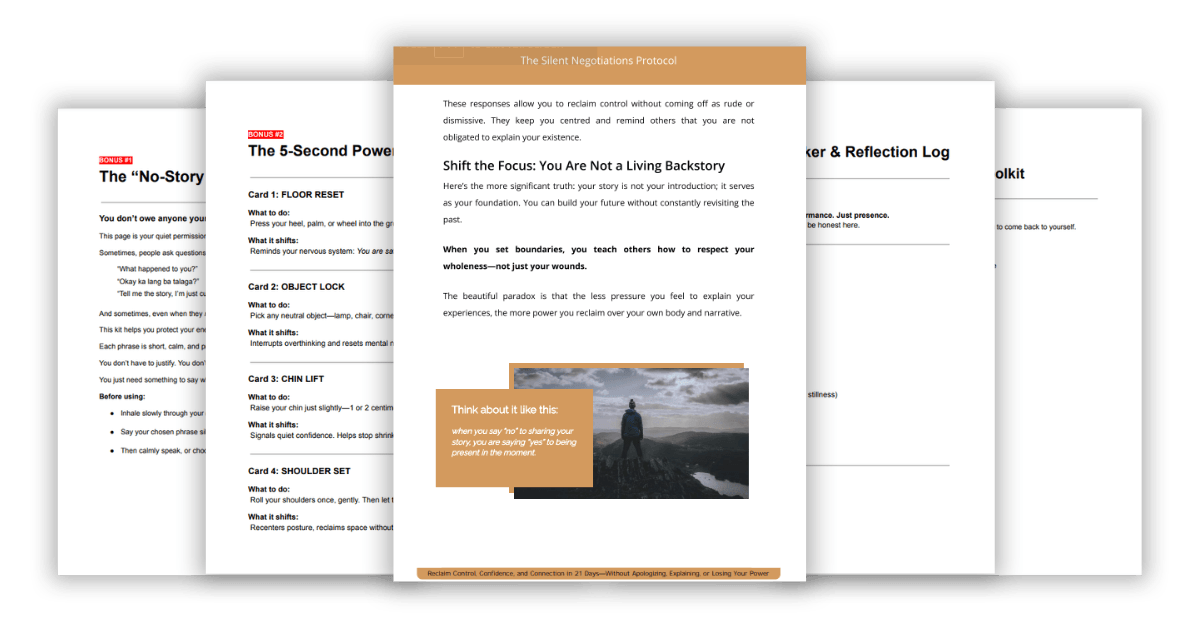
Four bonus tools — the system in daily practice.
30+ situation-specific phrases for strangers, coworkers, and family. Taglish versions included. Printable wallet card. Para sa mga pagod na mag-explain.
10 printable pocket cards — one silent body reset each. Invisible in public. Powerful enough to shift the room before you say a word.
21-day printable log. Track boundaries, quiet wins, and emotional patterns. Weekly review page included. No applause needed. This page is for you.
Quiet resets by situation — can't leave the room, people talking at you, in transit. Silent exit phrases for the hardest moments.
Not invented. Researched, tested, and documented.
Over months of journaling, experimentation, research, and real-world testing — the exact tools that reclaim confidence in public spaces, difficult conversations, and everyday interactions were documented into a repeatable system. This is a methodology. Not a diary.
Built from real daily negotiations — not theoretical scenarios or clinical observation.
Grounded in emotional labour theory, identity disruption research, and trauma-informed communication frameworks.
Based on Dr Dan McAdams' research on how the stories we tell shape our self-esteem and resilience.
Informed by Nedra Glover Tawwab's work and Bessel van der Kolk's trauma-informed communication models.
Mehrabian's communication model and Amy Cuddy's research on how posture shapes both perception and internal confidence.
James Clear's research on identity-based habits — why small consistent actions outperform grand gestures every time.
A methodology — not a memoir.

I created this because I lived these moments — the frozen responses, the sympathy smiles, the exhaustion of explaining myself to people who only wanted a quick answer.
Over 18 months, I documented more than 200 real-life social interactions, tested dozens of response frameworks, and studied behavioral psychology, trauma-informed communication, and narrative identity research.
Hindi ito diary. Ito ay isang sistema na nasubok sa totoong buhay. A system tested in real life, grounded in research, and built for people like us.
— Arela Ems · Creator, The Silent Negotiations Protocol
Honest answers to the questions you're probably asking.
Designed primarily for the 0–3 year window — when the social dimension hits hardest. But many readers who have been living with disability for years find it equally valuable. If you still encounter intrusive questions, sympathy fatigue, or moments where you feel unseen — this was written for you.
Yes. The social challenges of invisible disability are often harder — you're also navigating disbelief and the pressure to "look sick enough." Every tool in this guide works regardless of whether your disability is visible.
No. You won't find "everything happens for a reason" or pressure to perform positivity. What you'll find is honest acknowledgement of how hard this is, and practical tools that work even on the days when you feel nothing like the strong person everyone keeps calling you.
Each chapter ends with a Quick Win that takes under 10 minutes. On low-energy days, even one phrase from the Scripts Kit bonus is enough. You go at your pace. Always.
Two payment methods at checkout: PayPal (credit card, debit, PayPal balance — available worldwide) and Xendit (GCash, Maya, BPI, BDO, UnionBank, and other local Philippine banks). Both give instant access after payment.
Real Moments This Helped Solve
The next time someone asks "What happened?"
you already know exactly what to say.
You don't freeze. You don't over-explain. You answer on your terms — or choose not to at all. And either way, you walk away feeling whole.
You walk into a room and feel present instead of exposed. The stares don't shrink you. Your posture does the talking before you say a word.
You end a conversation without replaying it for hours afterward. Your energy stays yours. You stop managing everyone else's discomfort.
You look in the mirror and recognise yourself again. Not the before version. The now version — whole, present, and still writing the story.
"That's what we're building. One quiet interaction at a time."
Now let's give you the tools.
Everything you get today — at one price, forever.
You save $80 · Founding Member Pricing · One-Time Payment · Yours Forever
Get Instant Access — $17 →One uncomfortable conversation can stay with you for days.
One family gathering can drain an entire week.
One stranger's comment can replay in your head long after you've gone home.
This protocol won't change what happened.
It helps change what happens next.
And once learned, these tools can be used for years.
Read it. Use it. Try the exercises. If you don't feel more prepared for difficult conversations within 30 days — email me and I'll refund you. No forms. No explanations. No guilt. I'll carry the risk. You carry only the possibility of feeling stronger, calmer, and more in control again.
What people are saying.
★★★★★
I stopped over-explaining myself after Chapter 4. That alone was worth it.
Diane R., 47 · Stroke survivor · 14 months post-diagnosis
★★★★★
Used the 'How Are You' scripts at a family lunch. First time in months I didn't leave exhausted.
Marco S., 39 · Car accident · 5 months post-injury
★★★★★
Finally something that doesn't tell me to stay positive. Just actual phrases I can use. Finally something that doesn't tell me to stay positive. Just actual phrases I can use.
Trish M., 53 · Chronic illness diagnosis · 2 years in
★★★★★
Ginamit ko 'yung boundary phrases sa tita's ko. Nagtaka sila. Hindi ako nagpaliwanag. Paldo Talaga.
Jessa L., 44, Manila · Spinal injury · 8 months post-accident
But you still hold the pen.
Whether you're newly disabled or still adjusting to your new normal — this isn't the end of your story. It's the rewrite. Sama-sama nating gawin.
I'm ready — get my copy →"You may not control all the events that happen to you — but you can decide not to be reduced by them."
— Maya Angelou